CLIP 1: In this clip at 0:48 there is a shot of a brain scan which we thought would be quite useful to use in the montage as it links to the psychological genre.
The colours in this were different shades of blue which also links in with the modern interpretation of horror.
CLIP 2: We also thought including news clips about mentally ill people would be effective, and so we found this one where at 29 seconds the woman says 'mentally ill.'
This could be a very short jump cut in our trailer within the montage, we decided to choose a news clip because it has a professional feel. CLIP 3: This clip is another news report which we thought we could use. The beginning of the clip is the part we are most likely to use as the news reporter states that he is going to a mental hospital. There are also parts where they are talking about the man's insanity plea. This would obviously link to our trailer quite well and could also be included in the montage.
CLIP 4: The beginning of this documentary has old footage of people gagging an insane woman. We felt this would be another good clip to put in the montage because it could demonstrate her fears.
The effect of this scene is quite creepy and therefore would work well with our genre of psychological horror.
CLIP 5: At 27 minutes 07 seconds there is a shot of a man saying in another language that 'Mental Illness is a hereditary evil."This would clearly put across our point about discrimination and about the bad attitudes people have towards mental illness.
CLIP 6: In this clip there is a shot of the news reporter saying that man stabbed himself and decapitated his cat 'because the voices told him to.'
The part about the voices could be used in the montage parts as once again it links to our trailer but this time its much more explicit as we also have voices in our trailer.
Evaluation
We would probably use most of these clips as they will only be a few seconds long however the last one might not be used as it is rather modern and it doesn't seem particularly professional. The rest of them however are relevant to the trailer and are all quite short.
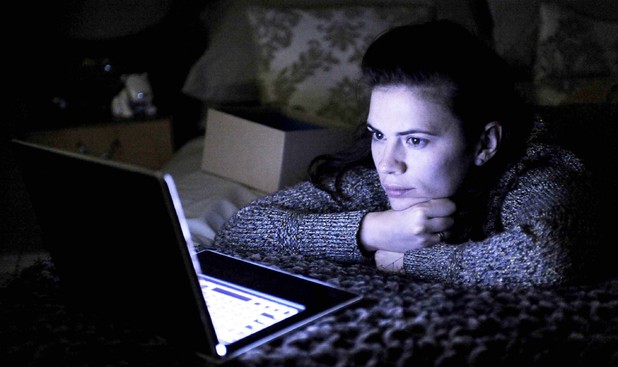
Online activities When researching social networking in more depth, it became clear that there are a lot impacts stemming from our online activities. I used the episode of Black Mirror called 'Be Right Back' to help me investigate further. The idea of the episode it to remind us how much information we post about ourselves onto the internet. Every tweet, every status update, every Instagram photo, it's all there, forever. It is important to address this when thinking about social networking as a cultural influence for our trailer, as we could focus on how our lives are saved on the internet, and all these virtual moments will last longer than us. The program uses technology that we do not have, but it is a good way of demonstrating how in the near future, technology enabling us to 'talk to the dead' via an app, or other means of communication could become widely available, especially with our internet history - forever
expanding everyday.
Privacy
We can also link this idea to privacy. In the last post, I mentioned how nothing is really private, as everything is uploaded onto the interent and is available for anyone to see. In the program, this can be identified as the character 'Ash' is drowning in social networking. He is obsessed by sharing things he encouters, and even admits he does he because it might be entertaining to somebody. On a daily basis, we share comments on Twitter about what we have done, or our opinions on a 'trending topic', this has become addictive for many, as we don't do it for a reason, it is just a long time habit.
Who are we talking to?
Another point which is interesting to point out is the idea that we never really know who we are talking to. There are multiple profiles which can be made to look realistic by having a picture and a few pieces of general information, almost like the episode when the protagonist uploads all the data so a fake profile of Ash can be created. We never really know without talking face to face about whether their profile is real or not. This could cause concern when thinking about privacy as we share information online with our friends. This can allow people to steal infornation and also make our profiles vulnerable to being faked too.
Social Networking
Social networking can also make us neglect events in the real world. We become so immersed in the virtual world that we forget there are things happening around us. This is seen when Ash is paying so much attention to his phone he doesn't even realise his girlfriend is trying to get in the car. We should consider thjs when thinking about ideas for filming because we could use it in a scenario about a character who is so oblivous to their surroundings that they are in trouble and have lost sight of what really matters.
It appeals to the vast majority as most of us that own a social networking account e.g. Facebook, Twitter, Instagram and Youtube. With 1.06 billion monthly users recorded on Facebook.
Due to the large audience we can easily pinpoint the dangers, deterring them from actions that may be wrong on social media sites.
There are a lot of cases that can be linked into it (e.g. the lack of privacy we have, the phone hacking scandals)
Cons:
It may not cater for an older audience (e.g. the use of technology may be too advanced).
The lack of privacy and safety on the internet is something that we are all reminded about on a daily basis, therefore a lack of originality may come across.
Social Isolation Pros:
It doesn't affect too many people, in the case of Joyce Vincent the case was extremely covered up in terms of details therefore we would be able to illustrate the problem that social isolation creates.
The are many extreme cases that are censored by the media; by taking social isolation on board we may also be able to link in the censorship of cases that arguably should be heard of.
Cons:
It's not hugely focused on, even in the media therefore there may be a lack of interest in these sort of moral panics.
The background of the individual may be too complex to fit into a trailer - in the sense that Joyce Vincent had problems, health, family, relationship and money wise.
Drugs
Pros:
It's a worldwide problem.
Use of extreme cases can be used as a deterrent for those who do use drugs.
Too, it's also a moral panic that many people are aware of - due to the widespread use of drugs, it would be easy to look into the lack of control that we seem to have over the selling and use of drugs.
Cons:
As mentioned in the previous bullet point, drugs as a moral panic has been highly evaluated and we are all aware of the increase of it lately therefore the originality of a trailer focused on drugs may be diminished.
Crime and Punishment
Pros:
Again it can make teenagers aware of their actions and the consequences that may follow.
It can highlight the distinctions between countries as some still permit punishments such as the death penalty (such as some states in the US).
It would open an opportunity to see crime and punishment through the perception of a teenager (e.g. their thoughts/fears etc).
Cons:
It's a controversial issue: can create an uproar with the audience (discussion of morality within the death penalty, "an eye for an eye, a tooth for a tooth")
Mental Illness Pros:
We can see the contrast from what they think is acceptable against what we deem to be acceptable - this could be linked closely with the documentary regarding the mind of a serial killer and their motives.
Similarly, to social isolation, mental illness is too a case that it likely to be censored as either the antagonists motives may have been beyond their control so the verdict of the case could be extremely controversial.
Cons:
It also can be seen by some as being controversial as the killer may be unaware of their actions.
CCTV & Privacy
Pros:
CCTV is everywhere as we are all aware but the fact of us being watched every moment is something that we don't tend to remember half of the time. Therefore the lack of privacy that we don't have may be a shock to some, although we know it's for our protection in most cases.
We can make teenagers more aware of their duty to behave morally right and take into account their responsibilities as young adults.
Cons:
Charlie Brooker's White Bear focuses introduces the lack of privacy that we have but it's taken to an extreme, as all bystanders monitor one individual as she is released from prison. Therefore some ideas may have been pitched already through this series.
It would be hard to not illustrate high authoritative figures (e.g. the police) in a negative light therefore posing some difficulties.
Overall, our ideas all lean towards a large target audience, with a moral panic of say, mental illness we can open our ideas to a younger audience as well as an older audience as it's a relatable subject. On the other hand, we can choose one target audience and suit our trailer to their tastes such as the moral panic of drugs, similarly, we can always take drugs as a social issue but apply it to an older character subverting viewers' expectations. In terms of a final idea, narrowing our research ideas to an issue that has already been heavily documented on may seem a bit too repetitive, so perhaps choosing an issue that has not been touched on a lot by the media will be a better alternative.
The UK is the country with the most CCTV cameras per person in the whole world. We therefore thought we could comment on the current situation at the moment, as many people are realising that we have less and less privacy. This is because according to the guardian 'CCTV increases people's sense of anxiety' and actually doesn't make people feel safer.
We are also getting less and less privacy through the fact that we can also be tracked through social networking.
Our idea
The idea of constantly being watched is a particular favourite to the group.
In order to exaggerate this idea we were thinking of using other means such as having cameras on mobile phones and computers/laptops always on, giving the impression that the government or the police have completely taken away our privacy in order to maintain a safe country.
The development of our idea
We thought of this idea very early on and since then it has adpated. To being with we thought we would just track a girl through different means (CCTV, mobiles, laptops, cameras) however we soon realised that this would prove to be a rather boring movie. Therefore we are now building on a different idea by creating an exciting and crime related plot line for this girl to have, combined with her every move being tracked by the police. We all quite like the idea of having her realise at the end that she has always been watched through technology, with this the idea of zooming out of the frame she is in to reveal more people around her was another favourite as we'd be able to show that everyone was being watched.
A final thing we were considering was including social networking and showing how the girl was traced through that, there were many ways we were thinking of doing this, one being a timeline of all the different websites she had joined and all the activity she had done on them. This would show that nearly all the gaps of her life would be filled in by using technology.
Since 1982, there has been at least 62 mass murders across
the USA and acute paranoia, delusions and depression have been common mental
illnesses among these killers, with at least 35 committing suicide on the
scene. So what leads one mentally ill person to violence but not another? It
may be the stigma of mental illness that provokes it, by increasing the
existing symptoms of delusion, disconnection from reality and social withdrawal.
Symptoms of Schizophrenia
Delusions and auditory/visual, hallucinations.
Disordered thoughts and speech.
Sloppiness of dress and hygiene, and loss of motivation and
judgment.
Pattern of emotional difficulty, for example lack of
responsiveness.
Paranoia.
Social isolation.
Substance abuse.
Stigma of Schizophrenia
Discrimination
A survey of attitudes towards schizophrenia showed that:
80% expressed discomfort with the prospect of dating someone
with schizophrenia.
77% would feel uncomfortable working with a schizophrenic
person.
60% think that violence is a symptom of schizophrenia.
71% would be afraid for their safety around a schizophrenic
person.
This leads to the exacerbation of the symptoms of
schizophrenia, increasing social isolation and worsening paranoia and
delusions.
Experience of Schizophrenia
Here is a quote from someone's experience of having
schizophrenia in a discriminative society which does not understand the
symptoms. After the school shooting in Northern Illinois University on 14th
February, surrounding areas and also the nation as a whole increased their
suspicious attitude towards schizophrenia sufferers. He documents the behaviour
which was conducted towards him, all of which explains why schizophrenic people
can feel isolated:
"I was diagnosed with schizophrenia just a month after
Steven Kazmierczak (quickly identified as “schizoaffective”) shot six people to
death on the campus of [Northern Illinois University] … Undoubtedly primed by
this shooting, wary, uncertain, without enough time to think, my doctoral
adviser suspended my graduate assistantship, banned me from the university, and
alerted all faculty, graduate students and staff to forward all emails [from
me] to her and, under no circumstances, respond."
This quote portrays the thoughts and feelings of a
schizophrenia sufferer after finding out about their illness. This explicitly
shows how the stigma of mental illness can have the effect of worsening one's
own perception of their illness, and how it can cause sufferers to feel as though
there is no hope for them. I thought the language in the passage could be used
in our trailer to express the sheer hysteria and depression of someone after
being diagnosed with a mental illness:
"Everything I have ever been told was a lie. My one way
out — of poverty, desperation, madness — was never more than an illusion. And
then disbelief. And then, how will I ever explain this to anyone, to family, to
old mentors? And then betrayal. No language this time, no thoughts; crying,
crying for hours. Alcohol, unconsciousness, unbidden dreams. Even there: repeating their words, over and
over and over again. Isolation so intense, there is no way I will ever bridge
it. I am lost. Days go by, weeks."
The quote goes on to explain how they are forced to feelings
of violence and murder, using graphic imagery which we could replicate in our
trailer to display the harrowing thought process:
"I fixated on a single vision, me, sometimes hanging,
sometimes with gun in hand and a pool of blood on the floor, outside [her
former adviser's] office. Suicide, yes, obviously, but also something more:
revenge."
Living with schizophrenia
Watching this documentary, named "Living with
Schizophrenia" helped me understand fully the illness and many aspects
surrounding it. It featured four characters, three with Schizophrenia and one
with schizo-affective disorder who each in turn spoke about their experience of
the illness. It taught me many different things which previously I may have not
thought to explore. Firstly, the interviewees spoke about medication. They
discussed how the usual perception of society is that by taking medicine one is
instantly "cured" however, one character in particular discussed how
mediation was only one answer for her, and that many other processes had to be
undertaken before she was able to feel stable in her daily life. They also
expressed how they felt that doctors and psychiatrists did not understand them,
and how they felt too insecure to ask questions about their medication and the
side effects attached to them, which were abundant.
Many of them spoke too about how the stigma surrounding
their illness was almost as horrific as the symptoms themselves. One discussed
how the internalisation of stigma was extremely dangerous and that it caused
incredible despair, confessing to the audience that he has had a multitude of
schizophrenic friends who have been led tocommitting suicide. In fact, 15% of
schizophrenia sufferers will commit suicide in the first five years of being
diagnosed. The character said how he believed that the lack of someone to talk
to was one of the major causes of this.
The many stages of acceptance after diagnosis, including
anger and denial, were discussed profoundly in the documentary. One showed the
audience how drawing was a method of
catharsis for him, allowing himself to express his complicated and sometimes
dark emotions. Another spoke about the negative social effects the illness
caused, saying that the memory problems which came with it meant he had
increasing trouble getting jobs. It was also obvious that sufferers found
getting back into relationships and work a lengthy and enduring process as
isolating themselves from society seemed a much safer and more appealing option
to them.
Child Schizophrenia
This documentary was about a rare case of childhood schizophrenia,
found in seven year old Jani. The illness causes the young girl to hallucinate,
and she is constantly telling her parents about her imaginary friends
"Wednesday the rat" and "400 the cat", both seeming scarily
real to her. These delusions and also voices inside her head cause her to be
violent and sometimes disturbed.
The illness is very rarely found in children, and a doctor
from UCLA psychiatric hospital claimed to have only come across a handful in
his lifetime. However, it is extremely crippling for Jani's family and forced
the parents into buying two apartments, one for Jani and another for her
younger brother in fear of the violence she could be capable of inflicting upon
the toddler.
The parents were insistent that they did not want Jani taken away
from them, and put into special care. However, Jani's illness makes her
incredibly tiring as her parents must engage with her at every moment during
the day or else she may slip into psycosis and her hallucinations will
overwhelm her.
Ideas for our trailer
We could include many aspects of this research in our
trailer for instance by having:
One main character with a mental illness.
Character suffering from discrimination.
Character forced to violence by stigma replicating that
quoted earlier.
Complex fractured editing to illustrate the mind of a
schizophrenia sufferer.
Graphic dramatic shots to mimic the horror of mental
illness.
A Link with social isolation research on Joyce Vincent and
give character a morbid end somehow.
This video talks of the severe drug addiction in Afghanistan and how it is used as a painkiller as they cannot afford anything else. It is also used to stop hunger so people eat less and therefore are able to survive for longer.
Many of these addicts are at a very young age, sometimes as young as three years old, and due to the horrendous poverty many children have to work to get money for the drug. In this documentary there is a young child who is working as a child prostitute in order to fund for his habit.
This video talks of a new drug called Krokadil which makes the skin scaly and start to rot. The drug is named Krokadil because it resembles the skin of a crocodile. This drug can easily be made by legal products from the pharmacy and is extremely dangerous.
After seeing many clips I have noticed that the boom in herion and opium is due to the war against the Soviets in Afghanistan, as the Afghans started growing opium in order to fund for the war. This has now led to a widespread drug addiction in many areas, especially Afghanistan itself and Russia.
Trainspotting
This movie follows a group of friends all addicted to heroin and shows how deeply the drug has affected their lives. Renton, acted by Ewan McGregor, is desperately trying to unhook himself from the drug in order to restart his life and apart from showing the horrible side of heroin he also explains the reasons why people get involved in drug use and the difficulty of stopping. (This can be seen in both the scene when he is preparing to detox and when his parents have locked him in his room) the poverty in Edinburugh in the 1980s is also demonstrated thorough this film and the desperate need for money, usually to purchase more drugs.
Dead Baby Scene
I think by far the most horrifying scene in this movie is when Renton awakes to Allison's heart broken sobs when she discovers that her baby Dawn has died due to neglect. This scene harshly demostrates the serious effects of the drug as it shows that when you are high you think of nothing else, nothing around you matters and you are living in your own world. However when you return back to your life there is much pain and misery, usually much more than a person who doesn't use drugs. This scene suggests it is a huge cycle as straight after discovering her baby's death Allison then goes on to ask for a hit for the pain she feels, so that she can forget everything that happened and keep her eyes shut. The fact that she does this shows that she hasn't learnt from her mistakes and that when it comes between heroin and her life she will always choose heroin. This is one of the main messages at the beginning of the movie:
'Choose leisure wear and matching luggage. Choose a three piece suite on hire purchase in a range of fucking fabrics. Choose DIY and wondering who you are on a Sunday morning. Choose sitting on that couch watching mind-numbing sprit-crushing ga me shows, stuffing fucking junk food into your mouth. Choose rotting away at the end of it all, pishing you last in a miserable home, nothing more than an embarrassment to the selfish, fucked-up brats you have spawned to replace yourself. Choose your futu re. Choose life. I chose not to choose life: I chose something else. And the reasons? There are no reasons. Who need reasons when you've got heroin?'
It is likely that Trainspotting was written as a reflection of the moral panic at the time, as the emergence of HIV/AIDS occured in the 1980s, when this book was set. This moral panic was used by the media to create a stereotypical image of herion users and it led to press sensationalism which gave the public incorrect information. The image people think of when talking of heroin addicts seems to be an ill, skinny and deciteful user who lives a life of crime and poverty. Many campaigns utilise heroin in order to shock people, such as the campaign in 2000 which shows a baby injecting himself with heroin and sitting on a pile of his own waste. This means that unhelpful information is being given about addiction and drug use, and there isn't enough proof to say that these campaigns actually scare people away from the drug. In fact it can be seen that these campaigns have actually increased experimentation. This is because creating a taboo around the subject therefore increases curiosity and also encourages teens going through a hard time to rebel against society and opt for the worst option due to the reactions of others.
If we were to use drugs and HIV/AIDS as our moral panic we could demostrate the causes of drug use and might dwell more on how the boom of drug making came about. An idea could be about the use of drugs as a terrorist attack on Russia, by exporting tonnes of heroin over the borders they both gain money from it and slowly destroy the country. The drug Krokadil could be used to create a horror movie about how people's skin turn scaly, and could be exaggerated for dramatic effect. We could also have a specific focus on terrorists and different methods used to slyly destory other countries.
Joyce Carol Vincent was a Londoner of Caribbean and Indian decent. She died in 2003 in her bedsit in Wood Green and her body lay undiscovered until 25th January 2006 even though her neighbours did smell her decomposing body.
Upon the discovery of her body, details were extremely 'hushed up' as not even her photograph or any background to her life was mentioned in articles.
The case of Joyce Vincent is an example of social isolation, a complete or near complete lack of contact with society. Channel 4'd documentary on her life before her death revealed her secrecy and lack of contact with her small group of friends and her family.
Similarly, the death of Michelle Conroy (21 years old) has direct links to Joyce Vincent's death as they both seemed to be victims of social isolation. Michelle Conroy was found dead after a tree fell on her tent whilst she was sleeping rough in Exeter. Michelle was often described as locals as "a lonely soul, with a sad, broken childhood who couldn't sustain an independent life". Like Joyce Vincent, Michelle Conroy spent time "sofa surfing": the invisible homeless person staying with friends when they can, maintaining human connections and temporary shelter. Michelle and Joyce both lived in poor conditions, Michelle was homeless and Joyce lived in council housing as depicted in 4OD's documentary "Dreams of a life". Similarly enough, they both had very little money yet their appearance never seemed to be at fault "Michelle has been coming to us for over a year. She was a lovely, polite girl, always well turned out with her hair brushed back in a ponytail. You wouldn't know she was homeless if you bumped into her." Rev Canon Anna Norman - Walker. Joyce Vincent was too always pristinely presented, therefore unlikely for anyone to have known of her isolation. Many critics link Joyce and Michelle's deaths with their housing and the isolation that it brought unto them. Joyce lived in a council flat alone, after "sofa surfing" for 6 months at an ex-boyfriends house. Michelle Conroy lived alone but the only difference being that she was homeless - she lived in shelters and was found dead in her own tent after sleeping rough in Exeter, after a tree fell. Both individuals isolated their selves to an extent, either due to a darkened childhood as discussed in 'Dreams of a life' or just pure social isolation such as Michelle Conroy. It was discussed that Joyce Vincent was left scarred after her mothers death when she was younger leaving her in the hands of her father who was illustrated as a rather irresponsible character, thus leaving Joyce to be raised by her older sisters, who remained anonymous for the documentary. Joyce was said to be of a 'secretive' nature, allowing others to find it hard to obtain information of her whereabouts or her early life. Her ex-boyfriend Garry Crystal allowed her stay with him for 6 moths after losing contact with Joyce for many years - upon her stay he noticed that she had multiple bruises that signified an abusive relationship that she may have had or may have been having at the time.
Today, we still deal with the risk that social isolation creates: "Social isolation is associates with a higher risk of death in older people regardless of whether they consider themselves lonely," BBC News have reported. Evidently, social isolation affects all no matter the age, gender or background. 2013 has seen a 26% increase in social isolation and the last 15 years has seen a 50% increase.