Danielle Blasse 7010 - Cloe Pace-Soler 7352 - Rebecca Holloway 7279 - Natasha Welch 7399
Townley Grammar School - 14109
Showing posts with label question 3. Show all posts

Monday, 31 March 2014

Evaluation Question 3 - Danielle

Evaluation Question 3

What have you learned from your audience feedback? 

Survey
  • After conducting a survey on the basis of our initial ideas about our 60 second teaser trailer the feedback we received helped us to establish large parts of the narrative and consolidate ideas that we had primarily agreed on. One of the main aspects that we chose to concentrate on within our survey questions was the representation of the protagonist and antagonist. 
  • We asked questions regarding mise-en-scene and costumes. It was a great opportunity to allow our audience to get a say during our planning stages of our overall package as it allowed us to air our decisions and obtain critical feedback that aided our decisions, as you can see from the image on the right

    YouTube
  • From our audience feedback we had to take on board a moderate amount of small changes. Reoccurring comments focused on areas of the sound and camera angles that suggested that the protagonist and antagonist had a friendship. After taking on board the feedback we made  final tweaks to the sound  by building the tension in the sound earlier before the montage scene to avoid a feeling of detachment in the sound.
  • Our audience noticed that the "booms" leading up to the montage were not effective enough, however after some consideration we realised that the build up in sound towards the montage was actually not effective enough at all.

  • To overcome this issue, we decided to not use the same "boom" track in the build up to the montage that is already being used in the montage. That way, the new timbre of the "boom" in the montage will have a bigger and more effective impact on our audience as it's not a sound that they have already heard in our trailer. It makes it less predictable. We decided to cut the piano track earlier than we had previously, therefore it didn't play during the montage scene.

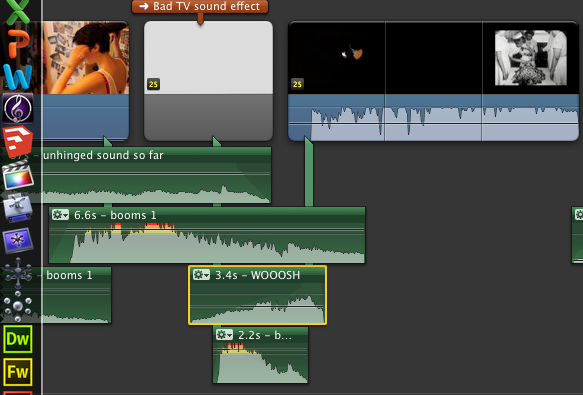
  • Additionally, we also also cut the "woosh" audio clip from one of our audio tracks that were previously used in the trailer and applied it to the end of the title to create a bridge passage between the sound of the scenes before and the montage scene. Once we had applied all of these changes to the sound, we copy and pasted the "booms 1" track below the "woosh" creating another layer but we cut to the climax of the "boom 1" audio clip and this added to the tension and created an entrance that was needed for the montage scene.
  • Furthermore, the "boom 1" track was cut as close to the climax of the track as possible, this way the booms got faster as we neared the montage building up suspense and anticipation in the trailer. Using track "booms 1" instead of the "booms" track which were used in the montage scene allowed us to pace ourselves a lot more in the build up rather than building up the tension in the wrong place altogether. Overall, this solved the problem and the booms used in the montage scene, proved to be more effective.


  • The feedback also allowed us to look at our trailer in a much more critical light and for us it definitely gave us the opportunity to be able to make informed decisions based on the response from our audience. It was made aware to us that the narrative may have been unclear at points in the trailer due to using camera angles and editing, therefore we chose to cut out on the amount of eye line matches we used between the protagonist and the antagonist. 


  • Our audience feedback benefited us majorly as it allowed for our audience to suggest what would be more effective and this solved the issue we had about certain parts of footage that we were indecisive to remove or keep. Our audience feedback also highlighted areas of our trailer that we had not picked up on such as the sound layers not following on from each other and certain camera angles making the narrative unclear to hard to follow. 

Thursday, 27 March 2014

Evaluation Question 3 - Rebecca


3. What have you learnt from your audience feedback?
Throughout the development of our three products, it was important that we gathered feedback from our audience so that we could be sure we were taking on the constructive criticism to make our final promotional package as professional as possible.

Survey
In December 2013, we decided to send out a survey to our peers to find out how effective areas of our narrative would be. We first planned a series of questions to ask within the survey, and then analysed the results.

In our survey analysis, we decided to ask a question to our audience by focusing on one area of our research, privacy.  we discovered some a range of results. When asking our potential audience which kind of camera would be good for showing the victim of our trailer being spied on, we found that a macbook or CCTV would work best. We decided to use a mac book as we had one of these within our group which we could use as a prop within the trailer.

After gathering these results, we used Photoshop to try and create the ideas our audience were looking for:


We also looked into how we were going to tackle our cultural link to metal illnesses and privacy issues, within the teaser trailer. In order to research this we asked the question 'Do you feel that the discrimination at the beginning should be subtle and barely noticeable, or very clear?' We thought this would be useful for us as we would be able to determine when to introduce our cultural link into our trailer. We found that overall it should be introduced quite subtly.

Above you can see the storyboard created from this research.We decided to add the library scene into our trailer, as we thought this would be a good way to introduce the idea subtly as our audience had suggested. It would then become more extreme, as you can see here:


After we had gathered all the results from our initial survey in December, we continued to film the rest of our teaser trailer and worked on planning how we incorporate our research ideas into our editing. In January we managed to create a draft of our trailer, incorporating the ideas given to us from the trailer as best we could. This allowed us to publish the version on YouTube ready for us to receive more feedback on our work for improvement.

YouTube Feedback
Here are some of the responses we received:

From this comment, we learnt that the genre of our film is very obvious from our teaser trailer, however our cultural link of discrimination against those with mental illnesses is perhaps not as clear as we had hoped. However, we can see that our use of media technologies seems to come across in a professional and effective manner, which is definitely a good thing.
Again, here we can see our genre is clear, however our narrative is very unclear to our audience. The idea of our protagonist being schizophrenic isn't clear enough or perhaps we don't have enough time to show our audience this in 1 minute.
From this comment, again is is clear that our narrative is not clear to the audience, but the locations do draw the viewer into our trailer, as they want to know why the characters are there. We have learnt that our sound isn't always perfect but have since been able to go back and improve the layering in iMovie.
This comment tells us that we have a few weaker areas, again the narrative is an issue, and we need to remove a few shots in order to make it clearer for our audience. It is perhaps the fact that we vary from location to location so much that it becomes confusing.
We learnt from this comment that our genre is clear, and that it is clear the protagonist is mentally ill, even if they don't realise she is schizophrenic. We learnt that our montage sequence really helps cement the idea of mental illness, however it is quite obvious we have used a green screen for parts of it.

Finally from this comment we learnt that again, it is obvious our protagonist is mentally ill, and the use of various shots such as the Facebook scene and web cam parts are really effective. This is good for us because we know that people are picking up on our cultural links.

Results and Improvements
Overall you could say that from our audience feedback we have been quite successful in the areas of editing, filming and sound. However it is clear we do have a slight issue with people understanding what our narrative is. This could be fixed by removing some shots which are possibly misleading to the audience, and that would hopefully help the whole teaser trailer flow better. What is apparent is that our montage sequence has been successful, because when people have realised the protagonist has a mental illness, it is often because of the montage. Another thing that was noted is that in some parts the green screen didn't come across as successful as we would have liked, but we did this to the best of our ability using the tools we had available to us.

From these results, we were able to go and improve on areas of our teaser trailer, we removed shots that were unnecessary and could be too confusing for our audience. We change the ordering of some shots and tried to implement the green screen footage with the other footage as best we could so that it didn't look out of place.

Monday, 24 March 2014

Evaluation question 3- Natasha

3) What have you learnt from your audience feedback.


Survey Feedback


Production

Feedback

  • When initially planning for our media products, we conducted a survey in order to help us make some important decisions about the production process. 
  • For instance, we asked our target audience: "would it be effective to use two cameras to achieve multiple angles?". Over 80% of responses claimed that, "Yes," it would be effective to make use of different cameras, and that it would not be too complicated. 


Development
  • Therefore we implemented this during our storyboarding stages. We took this into consideration in the scene where the protagonist stalks the victim via webcam by utilising the digital camera and the webcam camera to get a variation in shots and angles. 
  • This meant that we had a wider variation of shots and angles to use in the post-production stage, leading to a more professional overall product which really shows off our skills. We also developed this idea by adding in an overlay of a recording symbol on the footage recorded by a webcam. This emphasised the fact that it had been recorded by the protagonist and so have a creepy twist. 

Mise en Scene

Feedback


  • As well as this, we asked our target audience about the costumes for both the actors, asking "what style would be best for our character?"
  • The majority of respondents answered, ’Grungy look’, which we took into consideration when deciding on costume choices for our protagonist, which we documented thoroughly.
  • From this feedback, we went away and created, 'wardrobes,' for each of our characters.
  • This was due to our trailer form, which meant that we would include various scenes from across the timescale of the film and so the characters would not be wearing the same costume throughout.
  • When filming our scenes, we had a collection of costumes which we could go to easily which we knew suited our character profiles. This made the production stage of the process a lot easier. 
  • From the feedback we received about the styles of our key characters, we were able to make 'character profiles' to help us get a clear idea of what they were like and what mise en scene we wanted to surround them with. For our victim, we decided to make them have a mainstream style and typically 'girly.' We kept this mind when choosing the bedroom for this character.
 
Development
  • Once we had chosen the bedroom for the character, it was imperative that we changed the mise en scene. One of our main issues whilst filming was our location of the bedroom as the mise en Scene of the room was not suitable for the character that we wanted to convey. 
  • We immediately decided that major changes would need to take place within the room to make it suit the character, primarily by removing various items which clashes with the personality of the victim. This included all of the books on the bookshelf as we didn't perceive the character to be very interested in reading fictional works, the guitars in the corner of the room as we thought although she could be musical, these would distract from the main points we wanted to put across about her character. 
  • Then we went about adding in items that we thought portrayed our chosen character. We printed off posters of mainstream musicians and actors and stuck them over the walls and wardrobes. We wanted to give the room a cluttered effect and so we asked everyone in the group to bring round pink objects, makeup and shoes which we scattered around the room. We put beauty products on the shelves and threw different types of shoe on the floor in a random order so that it did not look too meticulously placed. 
Title
  • We also utilised audience feedback when considering the name of our film. We initially had a long list of film title choices which we were deliberating.
  • We cut this list down to 6 options and then conducted an informal survey by asking around and creating a tally for the number of support for each name. 
  • Finally, I created a pie chart which showed explicitly the popularity of each potential title. This helped us considerably when choosing the name as it meant we got an unbiased view, and we eventually settled on the most popular name which was, ‘Unhinged.’


Feedback: draft trailer


Narrative

Feedback
  • After we completed our trailer, we wanted to receive feedback to know what tweaks to make.
  • We uploaded the trailer onto youtube with a list of questions in the description, to help us get an idea of what we needed to change.
  • One thing that became obvious to us straight away was the unclarity of the narrative, as many comments expressed uncertainty for instance, "Something about a girl who is haunted by someone...?" 
 
Changes
  • Therefore, we decided to make the title slides longer and edited them so that they were 2 seconds each, as they were originally too fast to be able to read as we did not want to go over 60 seconds. However, we decided that we were more focused on the audience understanding the narrative and made some essential changes.
  • These allowed the audience to read the titles clearly, which meant they could absorb what the narrative is.
  • This also allows them to understand the initial equilibrium shown through the title, 'The medicine worked', which is lost in the middle, explained via the title, 'Then she was haunted by someone's thoughts.'
 

Feedback
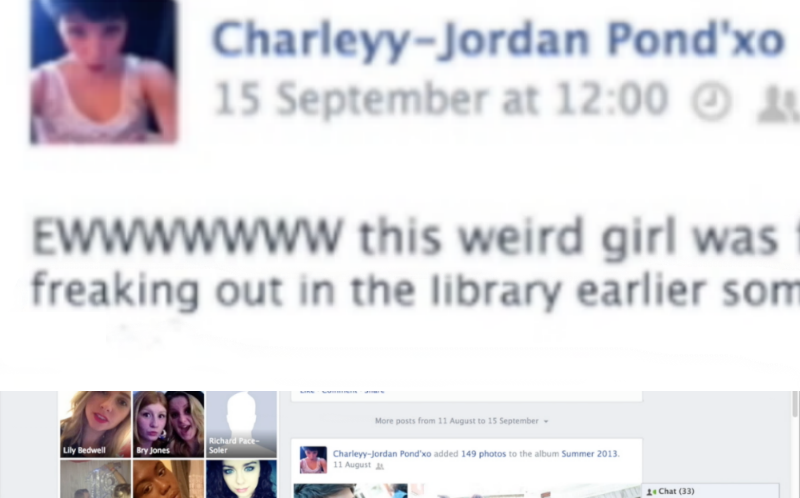
  • Linking in to the unclarity of narrative, we received a lot of comments about one scene in particular. This was the scene where the protagonist is seen scrolling down the Facebook page of her stalking victim, and witnessing many malicious comments - which appear in the background via chroma keying.
  • Many people did not think that the malicious comment which upsets the protagonist is clear enough, suggesting, "The narrative would make a lot more sense if the facebook status was longer and larger." 
  • Before the feedback, the comment was zoomed in a little bit and stayed on the screen for about 1 second. On top of this, the protagonist's head was directly in front of the wording. This meant that an essential part of the narrative was unclear as the audience could not understand what discrimination pushed the protagonist over the edge. 
 
Changes  
  • Therefore, we made some vital changes. I utilised photoshop to create a close-up of the comment as a large image.
  • Then, I imported it into Final Cut Pro and edited the scene so that the protagonist would disappear from the foreground so that the audience could clearly read what the comment said.
  • I also made this shot much longer than it was originally, to give time for the audience to read as it. It was important to ensure that effective transitions were used either side of this shot to make it fit in smoothly, and so I used ‘Static’ transition, ‘Style B’.
 

Sound

Feedback
  • We also received a lot of feedback about the sound, such "sound needs to be tweaked" and the sound, "needs cleaning up as at certain points the layering was a bit off." Therefore, we thought it important to focus on the soundtrack when changing things around. 
  • Before this feedback, the transition from the previous scene into the montage was a bit unprofessional and rigid. The non-diegetic soundtrack before the montage consisted of a soft, melodic piano track which very abruptly changed into fast-paced 'boom' sounds. Looking back, we did not think this was a very effective transition.
 
Changes
  • Therefore, we made use of the ‘boom’ sound effect leading up to the montage, layered over the piano soundtrack. This prepared the audience for the change in tone, rather than surprising them all at once and created a gradual sense of anticipation.
  • We also added a ‘woosh’ sound effect just before the montage, to add to the suspense and prepare the audience for a distinct change. We also faded out the piano soundtrack rather than end it abruptly, so that it would a more subtle change in sound.
  • This meant that the sound of the overall product seemed more professional and intricately layered so that although the change in tone at the montage still had a major impact and created tension, it did not seem out of place and transitioned smoothly.

Feedback: draft poster and website

Typography
 
Feedback
  • We also received some feedback concerning our poster and website, which we took into careful consideration. Our audience was concerned that the title of our poster was not large enough, making it not conventional of a film poster and also making it not very noticeable. 
  • Originally, the title was laid out along one line, which meant that it was squashed up in order to fit into the available space. This did not make use of the space on the poster and made the overall poster seem a bit empty and unprofessional. 


Changes
  • Therefore, I duplicated the file and changed it by making the title ‘Unhinged’ on three lines rather than one, and manipulating it so that it was slightly crooked. This made much better use of the space on the poster and conformed to the conventions of a psychological thriller much more. 


Development

  • However, we also then had the problem of the website, as the layout was then different to the poster which didn't create an effective promotional package combined.
  • Therefore, we had to make sure it was also the same style on the website, creating a transparent image of the title on photoshop which we could import onto Wix.
  • This made our products combine effectively as a cohesive promotional package which was also more conventional of the psychological genre.

Evaluation Question 3 - Cloé

3.)What have you learnt from your audience feedback?

Feedback from the survey
  • We initially sent out a survey to ask second opinions on the plot line of our trailer. From this we made many key decisions that were linked to our trailer.
  • Firstly when creating our trailer we felt it would be effective if our protagonist was to be spied on, however deciding which camera would be best to do this on was difficult. This was one of our first questions to our audience.
  • This feedback told us that the preferred camera would be a laptop camera and so we took this on board when filming the scene in which she is spied upon.
Development
  • We took this on board when editing our footage from our bedroom scene as we
    realised that we have to make it obvious she was being recorded from a laptop. 
  • This meant that we had to download a 'REC' sign and make it transparent through photoshop. Once we had done this we then imported it into iMovie in the corner of the video. 

  • Secondly, we were unable to decide whether subtle or obvious discrimination would be better in order to correctly portray our message. When we asked our audience the majority of answers thought that a subtle type of discrimination would be preferred, we felt that this was better as it would show the audience that the trigger for mental illness doesn't always have to be obvious.
Development
  • We took this on board when filming our footage and brainstormed different angles we could utilise to demonstrate that our protagonist had really been hurt despite the discrimination being quite subtle. 
  • We did this through a close up of our protagonist's face, while our antagonist walked past the camera. This meant that it was clear the antagonist was leaving the room straight after the protagonist's mental breakdown, and the audience would then see the protagonist's expression and how this had impacted her. 
  • We felt this was necessary if we were to include more subtle discrimination as otherwise it wouldn't have been noticeable that our protagonist was hurt and the meaning would have been lost. 


  • Finally we weren't sure if having the protagonist wear a mask would be freakier for the audience. However when we asked them they felt that the imaginary friend shouldn't wear a mask or animal ears. We felt that this was also a good idea as if we had used a mask it wouldn't have been as obvious that we were using chroma keying for some of our scenes. 
Title
  • We also gained feedback on what our title should be. 
  • After giving our audience a selection of titles our trailer could be called, we clearly saw that the winner of these was 'Unhinged.' 
  • We felt it was important to listen to the audience as the title is key to attracting attention from them. 

Feedback from YouTube comments

  • We then completed our trailer and asked people to feed back on YouTube. This gave us a lot of helpful feedback. 
  • One main issue that many picked up was the facebook scene as many said the mean comment that triggered our protagonist wasn't clear. Because this scene is crucial in understanding our trailer, the fact the audience were missing this because it wasn't clear meant they weren't able to fully understand. 
Development
  • We therefore made this scene longer by a few seconds and had a close up of the keywords flash up along with non diegetic sound of 'freaking out in the library' so the message was clear.
  • We this shot up for a few seconds after this so that it was completely clear, and then followed this by our protagonist slamming the laptop down to clearly show she was hurt by the comment. 
  • By having her imaginary friend say 'Charley' we then clearly showed a link between her mental health and the discrimination. This demonstrated a cause and effect which was key to our meaning. 
  • Secondly, people found it difficult to follow the story because they found the titles were too short, therefore we made them all two seconds long and shortened any transitions so they weren't taking away length from the titles. This meant people had enough time to read what was being said and full understand our narrative. 
  • Suggestions were also made about various other bits to cut out. For example one comment (shown above) stated that a shot where our antagonist goes towards the webcam makes it seem like the antagonist and the protagonist are friends and they are communicating. This is clearly not what we wanted to show as our antagonist was being spied on in that scene. Therefore we took this advice on board and removed that part of the scene.
  • Comments were also made about how the montage scene was a bit unexpected due to the sound, for example they said that it jumped straight in without any warning. 
Development
  • We therefore made tweaks to this so cinematic booms were introduced much earlier in the trailer. This meant having subtle deep bassy sounds throughout the bedroom scene, so we could slowly raise the tension. This proved problematic as we had to make sure the 'booms' were at the same point as the beat in the piano song we had in the background. In the lead up to the montage we had to slowly decrease the volume of the piano music as many found this was anti-climatic. We then inputted a high pitched 'whooshing' sound that increased the tension just before the montage therefore warning the audience of the climax that was coming up. The high pitch noise ended just as the booms began therefore leading the audience straight into the montage scene. This meant that the montage scene wasn't as unexpected and so it signalled to the audience that we were nearing the climax of the trailer.